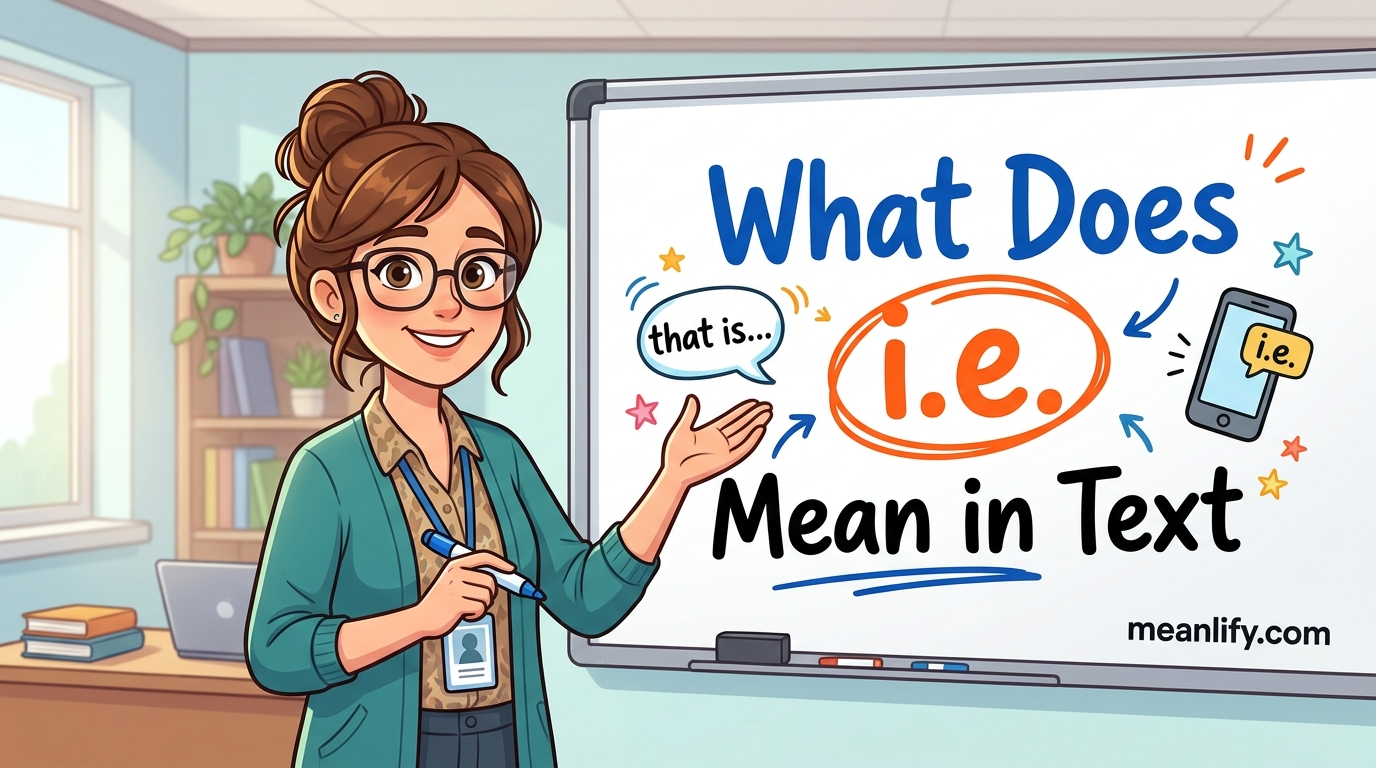
If you have ever seen “i.e.” in a text, caption, email, comment, or social media post, you may have wondered what those two little letters actually mean. Unlike many internet abbreviations, i.e. is not modern slang and has been used in English writing for a very long time. It comes from the Latin phrase id est, which means “that is” or “in other words.”
People use it when they want to explain something more clearly, give a specific meaning, or narrow down what they just said. In everyday digital conversations, understanding i.e. can make messages, posts, and comments much easier to follow.
What Does i.e. Mean in Text?
In text messages and online writing, i.e. means “that is,” “in other words,” or “more specifically.”
It is used when someone wants to explain exactly what they mean by something they have already mentioned.
For example:
“I only use social media for work, i.e., I don’t post personal stuff.”
Here, i.e. introduces a clearer explanation of what “for work” means.
Another example is:
“Let’s meet somewhere quiet, i.e., not at the mall.”
The person is making their meaning more specific.
So, whenever you see i.e., think:
“I mean this specifically.”
What Does i.e. Stand For?
i.e. stands for the Latin phrase id est.
The literal meaning is “that is.” In modern English, it is commonly understood as:
- That is
- In other words
- More specifically
- To clarify
- Namely
Although its origin is Latin, i.e. is commonly used in English writing.
You may see it in texts, emails, articles, school assignments, work messages, social media posts, and online discussions.
Is i.e. Slang?
No. i.e. is not internet slang.
This is an important distinction because people often search for abbreviations online and assume every shortened expression is slang.
Internet slang includes terms such as LOL, BRB, IDK, IMO, and TTYL. These are commonly associated with casual digital communication.
i.e. is different. It is a traditional abbreviation that can be used in both casual and formal writing.
For example:
“I prefer warm colors, i.e., red, orange, and yellow.”
You could use this in an everyday message, but you could also find i.e. in a professional document or academic text.
What Does i.e. Mean in a Text Message?
In a text message, i.e. usually means “that is” or “in other words.”
Someone may use it to make their previous statement easier to understand.
For example:
“I’m free this weekend, i.e., Saturday and Sunday.”
Or:
“I need a short break, i.e., about 20 minutes.”
In both examples, the phrase after i.e. gives more precise information.
It is especially useful when someone thinks their first statement could be misunderstood.
i.e. Meaning on Social Media
On platforms such as Instagram, TikTok, Snapchat, Facebook, and X, i.e. has the same basic meaning.
It does not suddenly become a different slang term just because it appears online.
For example, someone might post:
“I love simple outfits, i.e., jeans, sneakers, and a plain T-shirt.”
Or:
“I’m taking a digital break, i.e., no social media tonight.”
The abbreviation helps the writer clarify the statement that came before it.
On social media, people may also write “ie” without periods, especially in casual posts. The meaning is generally the same, although “i.e.” is the more traditional form.
What Is the Difference Between i.e. and e.g.?
One of the most common sources of confusion is the difference between i.e. and e.g.
They are not interchangeable.
i.e. means “that is” or “in other words.”
e.g. means “for example.”
Consider this:
“I enjoy citrus fruits, i.e., oranges and lemons.”
The writer is using i.e. to identify exactly what they mean.
Now compare:
“I enjoy citrus fruits, e.g., oranges and lemons.”
Here, oranges and lemons are only examples. There could be other citrus fruits the person likes too.
A simple way to remember the difference is:
i.e. = explaining exactly what you mean
e.g. = giving an example
Easy Trick to Remember i.e.
If you often forget whether to use i.e. or e.g., try replacing the abbreviation with “in other words.”
If the sentence still makes sense, i.e. is probably the correct choice.
For example:
“I want to visit a European country, i.e., France.”
You could say:
“I want to visit a European country, in other words, France.”
The sentence is understandable because France is being used to clarify the original statement.
With e.g.:
“I want to visit a European country, e.g., France.”
This means France is one possible example, not necessarily the only country the person has in mind.
i.e. Examples in Texting
Here are some natural examples of how people might use i.e. in digital conversations:
Example 1:
“I’ll be there in the evening, i.e., after 6 PM.”
Meaning: The person is clarifying what they mean by “evening.”
Example 2:
“I need something casual, i.e., jeans and a hoodie.”
Meaning: The person explains exactly what they consider casual.
Example 3:
“Let’s choose a weekday, i.e., Tuesday or Wednesday.”
Meaning: The writer is making the meaning more specific.
Example 4:
“I’m avoiding junk food, i.e., chips, candy, and soda.”
Meaning: The writer explains what they mean by junk food in this situation.
Example 5:
“I want a quiet place, i.e., somewhere without loud music.”
Meaning: The second part clarifies the type of place they want.
What Does i.e. Mean From a Girl?
If a girl uses i.e. in a text, the abbreviation itself does not carry a special romantic or emotional meaning.
It simply means “that is,” “in other words,” or “more specifically.”
For example:
“I want to go somewhere relaxing, i.e., somewhere away from the city.”
She is clarifying what she means by “relaxing.”
The meaning of the overall message depends on the conversation, not on the abbreviation itself.
What Does i.e. Mean From a Guy?
The same applies when a guy uses i.e. in a message.
It does not automatically suggest flirting, sarcasm, anger, or any hidden meaning.
For example:
“I’m staying home tonight, i.e., no parties.”
Here, i.e. simply introduces a more specific explanation.
If a message seems emotional or sarcastic, you need to look at the surrounding words and conversation rather than interpreting i.e. itself as slang.
Is i.e. Formal or Casual?
i.e. can appear in both formal and casual writing.
It is more common in written communication than in everyday speech.
You might see it in:
- Emails
- School assignments
- Articles
- Reports
- Work messages
- Text conversations
- Social media posts
- Online comments
- Websites
- Academic writing
In a very casual text, some people may prefer saying “I mean” or “basically” instead.
For example:
“I only want one thing, i.e., some peace and quiet.”
A more casual version might be:
“I only want one thing—I mean, some peace and quiet.”
Both communicate a similar idea, but they have a slightly different style.
Does i.e. Have a Different Meaning on TikTok?
No. i.e. does not have a special TikTok meaning.
If you see it in a TikTok caption or comment, it normally keeps its standard meaning: “that is,” “in other words,” or “more specifically.”
For example:
“My weekend plans are simple, i.e., sleep and watch movies.”
The abbreviation is simply helping the creator clarify the statement.
The same applies to Instagram, Snapchat, Facebook, Reddit, and other online platforms.
Does i.e. Mean “For Example”?
Technically, no.
This is one of the biggest mistakes people make.
i.e. = that is / in other words
e.g. = for example
Suppose someone writes:
“I like tropical fruit, i.e., mangoes.”
They are presenting mangoes as the specific thing they mean.
But:
“I like tropical fruit, e.g., mangoes.”
This suggests mangoes are just one example among several possibilities.
Using the wrong abbreviation can change the intended meaning.
How to Use i.e. Correctly
When using i.e., place it before the information that explains or specifies the previous statement.
For example:
“I work remotely, i.e., I don’t have to go into an office.”
You will often see a comma before i.e. and sometimes after it when the phrase is inserted into a sentence.
For example:
“I want a small pet, i.e., a hamster.”
Modern style guides can differ slightly on punctuation, especially around commas and periods, so you may see different formatting in different publications.
The important thing is that the abbreviation clearly introduces a clarification.
Common Mistakes With i.e.
Mistake 1: Thinking It Means “For Example”
This is the most common error.
Remember that e.g. is used for examples, while i.e. is used for clarification or a specific meaning.
Mistake 2: Treating It Like Internet Slang
Although i.e. appears in texts and social media, it is not a new texting abbreviation.
It has been part of written English for a long time.
Mistake 3: Assuming It Has a Hidden Meaning
If someone writes i.e. in a message, there is usually no secret emotional meaning behind it.
Look at the rest of the sentence to understand the person’s actual message.
Mistake 4: Using i.e. When the Meaning Is Too Broad
If you are giving only a few examples rather than defining exactly what you mean, e.g. may be more appropriate.
Compare:
“I like red fruits, e.g., strawberries and cherries.”
This gives examples.
But:
“My favorite red fruits are strawberries and cherries, i.e., those are the two I mean.”
This gives a specific clarification.
i.e. vs. “In Other Words”
In many casual conversations, you can replace i.e. with “in other words.”
For example:
“I’m looking for something affordable, i.e., under $50.”
You could also write:
“I’m looking for something affordable—in other words, under $50.”
The second version may sound more natural in a casual conversation.
However, i.e. is shorter, which is one reason it remains useful in writing.
i.e. vs. “That Is”
Another easy replacement is “that is.”
For example:
“The meeting is tomorrow, i.e., Monday.”
You can understand i.e. as a compact way of saying:
“The meeting is tomorrow, that is, Monday.”
This makes the abbreviation much easier to understand if you are seeing it for the first time.
Why Do People Use i.e.?
People use i.e. because it allows them to clarify, narrow down, or restate an idea without repeating a long explanation.
It can make writing more precise.
For example:
“I want to travel during the summer, i.e., June through August.”
The first part gives a general idea, while the second part defines exactly what the writer means by “summer.”
This is particularly useful when a word or phrase could have several possible interpretations.
Quick i.e. Meaning Guide
If you see i.e. in a message, remember:
Meaning: That is / in other words
Origin: Latin id est
Type: Traditional abbreviation
Used for: Clarification and specificity
Is it slang? No
Common online use: Texts, captions, comments, emails, and posts
Similar phrase: “In other words”
Do not confuse with: e.g., which means “for example”
Frequently Asked Questions
What does i.e. mean in a text?
In a text message, i.e. means “that is,” “in other words,” or “more specifically.” It is used to clarify or make a previous statement more precise.
Is i.e. slang?
No. i.e. is not slang. It is a traditional abbreviation from Latin that is commonly used in English writing.
What does i.e. stand for?
i.e. stands for id est, a Latin phrase meaning “that is.”
What is the difference between i.e. and e.g.?
i.e. means “that is” or “in other words,” while e.g. means “for example.” Use i.e. for clarification and e.g. when providing examples.
Does i.e. mean “for example”?
No. “For example” is e.g. The abbreviation i.e. is used to explain or specify exactly what the writer means.
Does i.e. have a special meaning on Snapchat or TikTok?
No. On Snapchat, TikTok, Instagram, and other platforms, i.e. generally keeps its standard meaning of “that is” or “in other words.”
Can I use i.e. in casual texting?
Yes. You can use it in casual messages, although phrases such as “I mean” or “in other words” may sound more conversational.
Does i.e. mean something different when a girl uses it?
No. The abbreviation itself does not indicate flirting or any particular emotion. Its meaning depends on the sentence and conversation.
Does i.e. mean something different when a guy uses it?
No. When a guy uses i.e., it normally has its standard meaning: “that is,” “in other words,” or “more specifically.”
Final Thoughts
So, what does i.e. mean in text? It means “that is,” “in other words,” or “more specifically.” Unlike popular texting abbreviations such as LOL or IDK, i.e. is not internet slang. It is a long-established abbreviation from the Latin id est and is used to make a statement clearer or more precise.
The easiest way to remember it is to think “i.e. = I mean exactly this.” When you see it in a text, caption, email, or social media post, look at the words immediately after it. They usually explain or narrow down the idea that came before.
And if you are ever confused between i.e. and e.g., remember the simple difference: i.e. clarifies, while e.g. gives examples.
Discover More Posts
https://meanlify.com/hy-mean-in-text/
https://meanlify.com/fuh-mean-in-text/
https://meanlify.com/url-mean-in-text/
https://meanlify.com/lll-mean-in-text/

Delilah is a curious author passionate about uncovering the meanings and nuances of language. She creates content that is clear, engaging, and easy to understand for readers of all backgrounds. At Meanlify, Delilah shares insights on modern communication, expressions, and slang, helping readers navigate the ever-changing world of words.